The Supreme Court will consider how affected parents and students may challenge racially discriminatory policies by public schools. The fight over renovations at East Potomac Golf Course continues - with Trump Administration lawyers requesting a judge be disqualified due to her “egregious” behavior. And the D.C. Circuit Court of Appeals prevents the Trump Administration from conducting immigration apprehensions at houses of worship.
Supreme Court to consider discriminatory school admissions

The Supreme Court has agreed to review Association for Education Fairness v. Montgomery County Board of Education, which challenges the racially discriminatory admissions policy of one of the largest school districts in America.
The Montgomery County Board of Education (MCPS), located in Maryland, maintains a magnet school program that provides a unique learning experience not available at other schools in the district. Concerned with the “under-representation” of certain races and the “over-representation” of Asian-American students, MCPS used admissions criteria to achieve “racial balance.” While the admissions process did not technically take race into account, it led to a substantial drop in Asian-American enrollment in the magnet school program. In other words, the criteria furthered a race-based policy while not being overtly based on race. This led to the lawsuit that challenged the admissions policy.
Currently, there is a split in the federal circuits concerning what a person must show to challenge these types of discriminatory school policies. In some circuits, a challenger has the high burden of demonstrating that the “admissions criteria suppressed the targeted group’s enrollment at least below the group’s share of the applicant pool.” In other circuits, a challenger “can prove intentional discrimination without such a stark showing of ‘aggregate underrepresentation.’”
To resolve this circuit split, the Supreme Court will consider whether those who challenge such policies as racially discriminatory “must establish that the targeted racial group suffered an aggregate disparate impact relative to its share of the applicant pool.”
We expect – and hope – the Supreme Court will clarify that intentional discrimination does not need to be proven in the aggregate. As the Supreme Court observed back in 2023 when considering a challenge to collegiate race-based admissions, “Eliminating racial discrimination means eliminating all of it.”
Contentious Fight over East Potomac Golf Course Continues
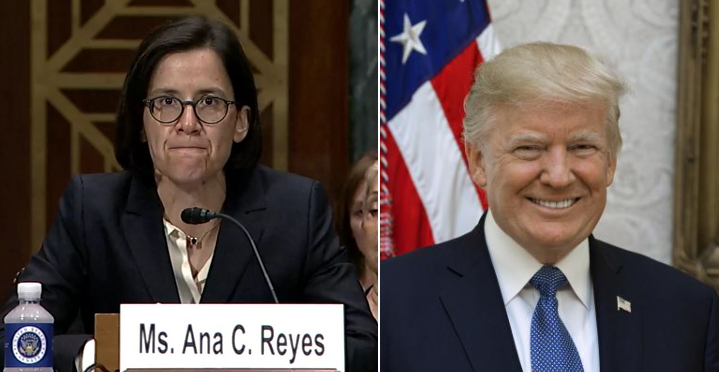
As we explained last week, United States District Court Judge Ana Reyes granted a temporary restraining order that prevented the Trump Administration from removing trees from the East Potomac Golf Course until Monday, October 26, 2026. That ruling came after an explosive hearing where Judge Reyes screamed at a lawyer representing the Government and accused them of losing “credibility” for not informing the Court of their plans to remove trees from the golf course.
Since then, the Government, led by Associate Attorney General Stanley Woodward, Jr., sought to disqualify Judge Reyes on the basis of her “egregious” behavior in this case that included berating Government counsel, her “systematic disrespect” for the Executive Branch, and her overall “pattern of animus against the Trump Administration.” Judge Reyes ultimately denied that motion.
There was also a lengthy hearing on October 19, where Judge Reyes demanded that Justice Department lawyers in attendance raise their hands if they agreed with a filing by Mr. Woodward concerning whether the golf course renovation was a “final agency action.” Mr. Woodward and the attorneys stood firm and refused, and Judge Reyes eventually withdrew that request.
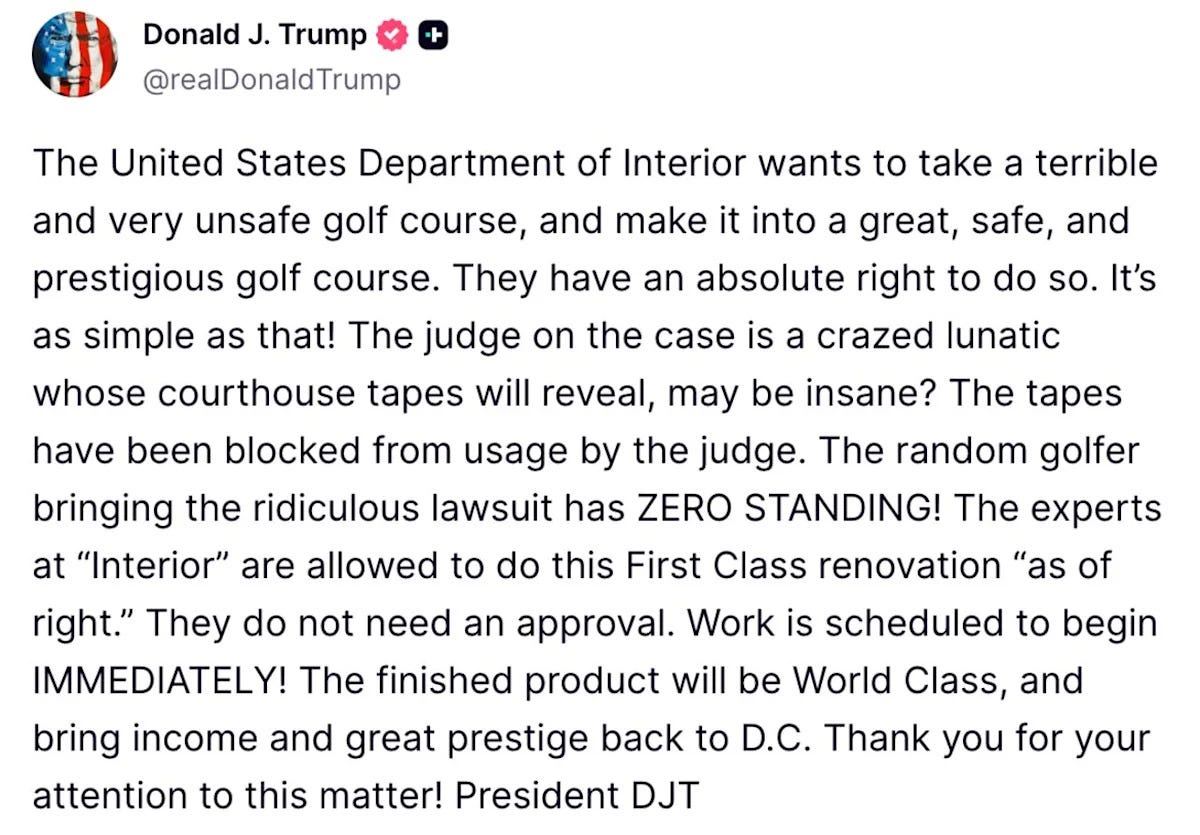
President Trump himself has been critical of Judge Reyes, correctly noting that the Department of the Interior has the right to renovate the golf course.
Currently, Judge Reyes is considering a motion for a preliminary injunction that would enjoin any further tree removal at East Potomac Golf Course pending the ongoing litigation. Given her history in his case, it is highly likely that she grants that motion.
D.C. Circuit restricts immigration enforcement
In a 2-1 opinion, the U.S. Court of Appeals for the District of Columbia Circuit sided with religious organizations who sought to prevent the Trump Administration from conducting immigration-enforcement operations at houses of worship.
In January of 2025, the Trump Administration announced that immigration officers could use “discretion” and “common sense” to apprehend illegal aliens from churches, mosques, and synagogues. This was a reversal of prior policies that attempted to avoid the apprehension of illegal aliens “on the premises of schools, places of worship, funerals and other religious ceremonies.” The Court of Appeals observed that the challenges of the policy likely faced “imminent harm from increased enforcement at their houses of worship” and that an injunction of the policy would “likely redress their injury.”
The dissent, written by Circuit Judge Neomi Rao, a Trump appointee, argued that the challengers to the new immigration policy lack standing because reinstatement of the prior immigration policy (the one that limited apprehensions at places of worship) is unlikely to “redress any of their asserted injuries.” She also noted that such a broad injunction that limits the power of the Executive Branch to faithfully enforce this nation’s immigration laws exceeds “the equitable powers of the federal courts.” This is yet another case that will likely head to the Supreme Court.
In other news:
On October 21, the Supreme Court entered an order denying a request from the Trump Administration to allow it to implement a new policy that would end “sex-trait-modification surgeries” and “hormone interventions” for “inmates with gender dysphoria.” Justices Thomas and Alito would have granted the Trump Administration’s request.
The Judicial Council of the Fifth Circuit Court of Appeals has released complaints and investigative findings regarding District Judge Ada E. Brown, who is believed by some to suffer “from a mental condition that renders her unable to discharge the duties of office.” An investigative committee determined that Judge Brown engages in “demonstrably egregious and hostile treatment of others”; that she sends “bizarre emails to court staff and judges”; and has refused to return to work or meet with supervising judges. At this time, her current cases have been reassigned and she is excluded from being assigned new cases.
Judge John Sinatra Jr., a Trump appointee, has ruled that New York’s law prohibiting residents from purchasing body armor for self-defense “violates the Second Amendment.” He reasoned that at the time the Second Amendment was ratified, the term “Arms” was understood to include “defensive body armor,” and he noted that the State did not “identify any well-established historical evidence to support its body armor ban.”